
Table of Contents
DTF vs DTG vs Screen Printing vs Sublimation vs HTV (2026 Full Comparison Guide)
Now that you understand what DTF printing is and whether it may be right for you, there’s one important step left before making any serious decision:
You need to see how DTF compares to other popular printing methods.
The reality is that every printing method has its strengths and weaknesses. There is no ‘magic’ option, and knowing each method gives you that last piece of the puzzle to complete your full picture plan.
Quick Overview of the Main Printing Methods
Here are the most common apparel printing methods on the market today:
- DTF (Direct to Film)
- DTG (Direct to Garment)
- Screen Printing
- Sublimation
- HTV (Heat Transfer Vinyl)
Now let’s compare them properly.
DTF vs DTG (Direct to Garment)
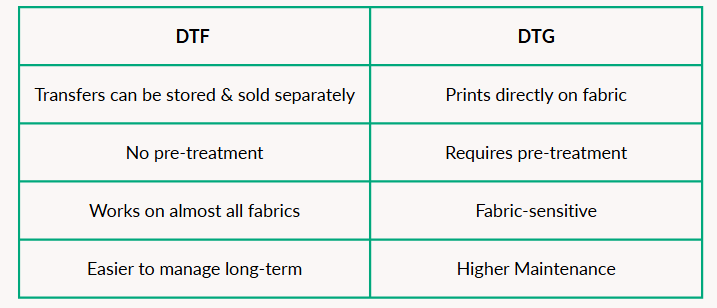
At first glance, DTF and DTG seem similar. Both use inkjet-style printers and produce full-color designs, but the workflow and flexibility are very different.
How They Work
DTG prints directly onto the fabric.
DTF prints onto film first, then transfers onto the garment.
That small difference changes everything.
Pre-Treatment
DTG requires pre-treatment on most garments (especially dark ones).
DTF requires no pre-treatment.
This makes DTF simpler for beginners.
Fabric Compatibility
DTG works best on cotton.
DTF works on cotton, polyester, blends, nylon, and more.
DTF clearly wins in versatility.
Maintenance
DTG printers are known for high maintenance requirements.
DTF still requires maintenance (especially white ink management), but overall it’s easier to manage long term.
Storage & Scalability
DTG prints must be done on-demand directly onto garments.
DTF transfers can be printed in advance, stored, and sold later.
This creates flexibility in production and even opens the door to selling transfers separately.
Verdict:
If you are printing mostly cotton shirts and want a soft “ink in fabric” feel, DTG may work.
If you want versatility, lower complexity, and more control over production, DTF is typically the better option.
DTF vs Screen Printing
Screen printing is the traditional giant in the industry. It has been around for decades and dominates large-scale production.
Setup Cost
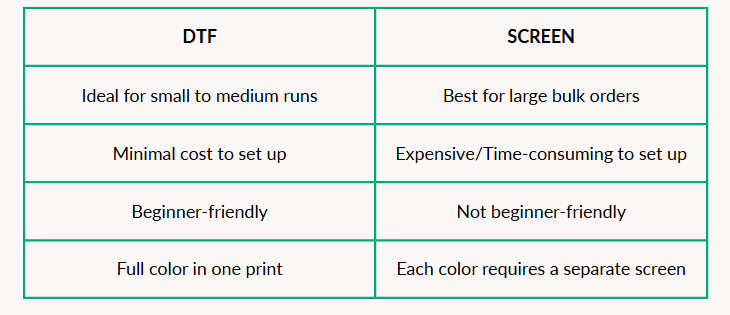
Screen printing requires screens to be created for each color in a design.
More colors = more screens = more setup time and cost.
DTF prints full color in one pass.
For small orders, DTF is far more efficient.
Order Size
Screen printing shines in large bulk orders (hundreds or thousands of pieces).
The more you print, the cheaper it becomes per unit.
DTF is ideal for small to medium runs (1–100 pieces).
For beginners or small businesses, this flexibility matters.
Complexity of Design
Screen printing works well for simple designs with limited colors.
Complex gradients and photographic images increase cost and setup complexity.
DTF handles full-color, high-detail designs easily.
Beginner Accessibility
Screen printing requires space, equipment, drying racks, and experience.
DTF has a lower barrier to entry.
Verdict:
If you plan to operate a large-scale production shop doing thousands of identical prints daily, screen printing is powerful.
If you are starting small, offering custom orders, or need design flexibility, DTF is significantly more practical.
DTF vs Sublimation
Sublimation is another popular method — especially in the custom product world, but it has strict limitations.
Fabric Restrictions
Sublimation only works on polyester or polyester-coated materials.
And it works best on white or very light garments.
DTF works on cotton, polyester, blends, nylon, and both light and dark fabrics.
That alone makes DTF far more versatile.
Feel of Print
Sublimation becomes part of the fabric. There is no “layer” sitting on top.
DTF sits on top of the fabric (like a bonded layer).
If ultra-thin feel is your top priority and you only print polyester, sublimation may win.
Color Limitations
Sublimation cannot print white ink. DTF can –This is why sublimation struggles on dark garments.
Verdict:
If you are producing light color polyester sportswear, polyester jerseys, or mugs and white-coated products, sublimation is excellent.
If you want full garment flexibility and the ability to print on dark cotton, DTF is superior.
DTF vs Heat Transfer Vinyl (HTV)
HTV is very common among hobbyists and Cricut users, but it operates very differently.
Workflow
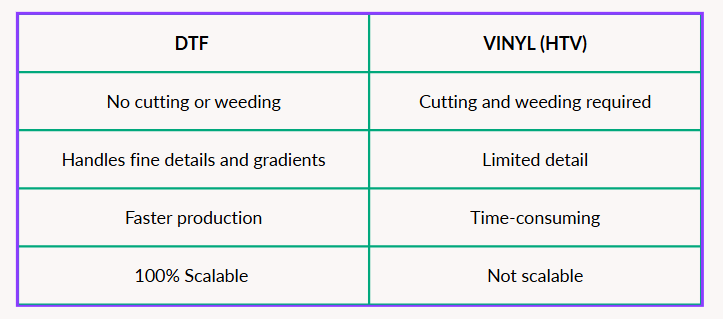
HTV requires:
- Cutting vinyl
- Weeding excess material
- Heat pressing
DTF requires printing and pressing.
No cutting.
No weeding.
This saves enormous time.
Detail & Gradients
HTV struggles with detailed designs and gradients.
DTF handles complex artwork easily.
Scalability
HTV is not scalable for serious production.
DTF is fully scalable.
Verdict:
HTV is great for beginners testing ideas or doing simple names and numbers.
DTF is far better for building a real apparel business.
So... Is DTF actually better?
Straight up… DTF is not “better” in every situation. It will always depend on your what you want and need. But it is the most balanced option for modern entrepreneurs.
It offers:
- Versatility
- Low entry barrier
- Full color capability
- Fabric flexibility
- Small batch efficiency
- Business scalability
That combination is rare. This is why DTF has grown rapidly in popularity over the last few years.
It bridges the gap between professional quality and beginner accessibility.
When DTF is NOT the best option
To stay objective, DTF is not ideal if:
- You only print massive bulk orders daily
- You want ultra-thin ink feel with no surface layer
- You refuse to handle printer maintenance
- You only print polyester sportswear
Every method has its lane. The key is choosing the one aligned with your goals.
Final thoughts
If you are:
- Starting a custom apparel business
- Building a clothing brand
- Offering small-batch printing
- Printing detailed multi-color designs
- Wanting flexibility and control
DTF is very likely the strongest starting point. It is powerful — but only if used correctly.
The method is the tool. The strategy is what makes money.
Now that you understand how DTF compares to every major printing method, you are in a much stronger position to decide your next move.
Your next step
If DTF seems like the right path for you, the next logical question becomes:
Which DTF printer should you actually choose?
Not all printers are built the same.
Not all are beginner-friendly.
And not all are worth your investment.
In the next guide, we break down:
- The best DTF printers for beginners
- What to look for before buying
- Common mistakes to avoid
And how to choose based on your budget